Elvis Aaron Presley 1960-1966 | Elvis Is Back!
Elvis Presley's life from 1960 to 1966.
 Elvis returns from the Army. He records the LP, Elvis Is Back and classic songs like 'Are You Lonesome Tonight' and 'It's Now or Never' followed by a TV Show with Frank Sinatra and a return to making movies starting with G. I. Blues. Elvis records his first gospel album, His Hand In Mine in October the same year. In 1961 Elvis stars in the Movie Blue Hawaii and records the classic songs, 'His Latest Flame', 'Little Sister' and 'Good Luck Charm', followed by 'Suspicion' and 'She's Not You' in '62. In '63 Priscilla Beaulieu moves to the USA to be with Elvis, Elvis meets Ann-Margret while his co-star in 'Viva Las Vegas'. In 1965 Elvis meets The Beatles. In '66 Elvis records his second gospel album, for which he recieves a Grammy award.
January 5, 1960 - Elvis is granted leave  from January 5 to January 17, including permission to travel to Paris.
This will be his third and final visit to Paris.
January 8, Elvis does a second phone interview with Dick Clark. A birthday party for Elvis includes 200 invited guests, including Priscilla. Joe Esposito and others present him with a trophy inscribed, 'Elvis Presley. Most Valuable Player. Bad Nauheim Sunday Afternoon Football Association, 1959'.
January 12, Elvis travels to Paris with Joe Esposito, Cliff Gleaves, Lamar Fike, and his karate instructor, Jurgen Seydel.
During the visit they attend five karate classes by Tetsuji Murakami, a Japanese teacher of the ahotokan technique.
January 20, Elvis is promoted to acting Sergeant three days after reporting back for active duty.
January 24, Elvis leaves for 'Operation Winter Shield' maneuvers in Grafenwöhr.
February 11, Elvis gets his full Sergeant stripes and throws a party to celebrate.
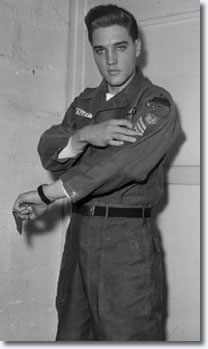
Friedberg, Germany,  February 20 : 1960 : Sgt. Elvis Presley of the U. S. Army's 3rd Armored Division gets ready to do an interview at Ray Barracks a few days before returning home and resuming his musical career.
 Sergeant Elvis Presley: Germany - Monday February 29, 1960
March 1, 1960, The Army holds a press conference just before Elvis' departure from Germany for Armed Forces Radio and Television, Elvis was asked about being in the field rather than entertaining in a service club. His response was, '. . . I was in a funny position. Actually, that's the only way it could be. People were expecting me to mess up (laughs), to goof up in one way or another. They thought I couldn't take it and so forth, and I was determined to go to any limits to prove otherwise, not only to the people who were wondering, but to myself'.
Sixteen-year-old Priscilla Beaulieu in Wiesbaden, Germany, on March 1, 1960
 Elvis in Europe: the NME interview with the King
With over 100 reporters and photographers in attendance, Elvis' commanding officer presents him with a certificate of merit citing his 'cheerfulness and drive and continually outstanding leadership ability'.
Also present is Marion Keisker from Sun Records, who as army Captain MacInness (her married name) has been serving her tour of duty in Europe. When Elvis, who has not seen her since since her 1957 enlistment spots her; he reacts excitedly, saying 'I don't know whether to kiss you or salute'. In that order', she responds.
March 2, The Elvis Army years come to an end on March 2 at 5:25 p. m. as Elvis leaves Germany and arrives in New Jersey the next day for a press conference. He is officially discharged from active duty on March 5, 1960, at 9:25 a. m. He boards a train for Memphis, arriving on March 8. Press and crowds of fans are everywhere for this historic series of events. He holds a press conference at Graceland in his father's office behind the mansion on March 8. He has served his country just like any other G. I. , with no special privileges his celebrity status might have afforded him. These two years away from his career have been a time to mature. He has also worried constantly that his lengthy absence might have damaged his career progress.
Elvis arrives at Rhine Main airbase with Priscilla Beaulieu . Waiting is a military transport to take Elvis and other GI's home. Priscilla is held back by military policemen as she tries to bid Elvis one last farewell.
Elvis Presley and Priscilla Beaulieu during their final moments in Germany: March 2, 1960.
Priscilla is captured by Life magazine waving goodbye, with the photo appearing in the March 14 issue and captioned 'The Girl He Left Behind'. Priscilla Beaulieu waves goodbye to Elvis, Germany, March 2, 1960.
Rex Mansfield boards the military transport first and selects two seats at the rear of the plane for Elvis and himself. Elvis boards from the rear of the plane to keep a low profile. Only a few people knew that Elvis would be on this flight. The plane takes off at 5. 25pm. News that Elvis presley was onboard spread like wildfire. The stewardesses were overjoyed and excited. A lot of them joined a line of passengers, mostly female dependants of other GI's on the plane, for autographs. After about two hours of this Elvis was tired and asked Rex to take over as 'bodyguard and spokesman' while he got some sleep. Elvis needed to be a fresh as possible to greet the press at Fort Dix. Finally the stewardess requested ever passenger to return to their seat. The plane lands to refuel in Prestwick, Scotland, before heading for New Jersey.
 March 3, Elvis arrives at McGuire Air Force Base near Fort Dix, New Jersey at 7. 42am, in the midst of a snow storm. Rex Mansfield said regarding the landing 'We could not see the runway until just before the plane landed. The pilot came down off-center on the runway and had to quickly go hard left. The plane swerved and the left wing almost touched the runway'. After processing Elvis through customs, the army holds another press conference, with a welcoming party that includes Nancy Sinatra, Colonel Parker, Jean Aberbach, and numerous RCA representatives. Elvis spends the next two days at Fort Dix going through the routine discharge procedure.
Elvis Presley at Fort Dix: March 3, 1960
March 5, 1960, Elvis is officially discharged from active duty at 9. 15am. Although the official date of release was scheduled for March 23. After receiving his mustering out check of $109. 54 and his formal honorable discharge (unlike his manager many years earlier), he and Colonel Parker travel by limousine, 'mysteriously vanishing', the press reports, 'from a snow-packed and fan-laden highway'. Their destination is a Trenton, New Jersey, hotel where they are joined by Lamar Fike and Rex Mansfield. That same evening, the group takes a private railroad car to Washington, D. C.
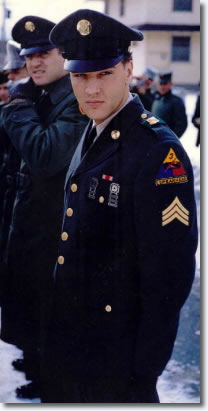
March 6, 1960, in Washington, Elvis and his party board a second private railway car, this time on the 'Tennessean' which leaves for Memphis at 8. 05 am. Elvis remains awake thoughout the night and throughout the trip, he appears on the observation platform in his dress blues and waves to the big crowds gathered at every station, big and small, along the route .
March 7, 1960, The train arrives in Memphis at 7. 45 am in the midst of another snow-storm. After greeting fans, Elvis rides out to Graceland, in his friend Police Captain Fred Woodward's squad car.
In the evening Elvis holds a press conference at Graceland in his father's office behind the mansion.
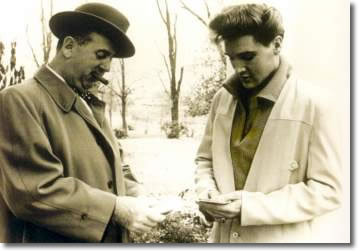
Colonel Tom Parker & Elvis Presley 1960.
Anita Wood joins him later in the evening after waiting patiently for her summons at his cousin Patsy's house.
March 8, 1960, Elvis visits Forest Hill Cemetery to see for the first time the marker and stone angels on t his mother's grave. Elvis visits his mothers grave at Forest Hill Cemetery : March 8, 1960.
March 10, Elvis attends the Holiday on Ice Show at Ellis Auditorium and renewed several acquaintances he made the previous year when he saw the show in Frankfurt, Germany.
There are four different Holiday companies around the world, but five members of the troupe now in Memphis were in the company Elvis saw in Germany.
March 12 and 13, Elvis Presley is playing host to the Holiday on Ice company today at Graceland  . Buses were to leave the Hotel Claridge at 2:30, carrying the entire company to Graceland to spend the afternoon.
March 19, Elvis rents the Rainbow Rollerdrome for an evening of roller-skating 'wars' with the guys.
March 20, Elvis has his first post-Army recording session. Some of the recording work is for the album 'Elvis is Back!', which will hit #2 on the Billboard pop chart. The album includes the single 'Stuck On You', which is rushed to the pressing plant and packaged in a generic sleeve without waiting for orders. Debuting at #84, it took only three weeks to hit #1. Sessions will continue in early April.
At noon Elvis, his entourage, Scotty Moore and D. J. Fontana (But not Bill Black, who never plays with Elvis again) take a charted bus to Nashville for a session at RCA's Studio B, whose recoding facilities have been upgraded with a three track machine. The are joined by all the musicians from the June 1958 session, the Jordanaires, Colonel Parker and RCA's new chief studio engineer, Bill Porter.
March 20, 1960 RCA - Studio B - Nashville, Tennessee
Make Me Know It L2WB 0081-19
Soldier Boy L2WB 0082-15
March 21, 1960 RCA Studio B - Nashville, Tennessee
Stuck On You L2WB 0083-03
Fame & Fortune L2WB 0084-sp
A Mess Of Blues L2WB 0085-05
It Feels So Right L2WB 0086-05
Elvis Presley : Nashville : March 21, 1960
Elvis Presley : Miami : Hotelroom : March 22, 1960
Elvis Presley and Sheila Riddell : March 24, 1960 Fontainebleau Hotel
 |
|---|
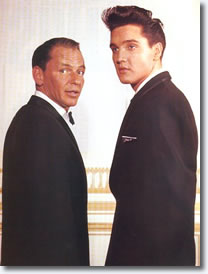
On March 26, The Frank Sinatra-Timex Special, also known as Welcome Home Elvis is taped at 6. 15pm for airing on May 12.
Colonel Parker had made the deal with the show's producers months before Elvis was released from active duty. He had hoped that appearing with Frank Sinatra would introduce Elvis as a pop singer to a wide audience made up of adults and pop enthusiasts as well as teenagers and country-western fans.
Never one to take chances, the Colonel made sure Elvis would make a big splash by packing the studio audience with 400 members from one of Elvis' biggest fan clubs. More on the show below.
The Frank Sinatra Timex Special - Welcome Home Elvis
Fontainebleau Hotel, Miami – 26. 03. 1960
Nelson Riddle Orchestra - Screening - May 12, 1960
Fame And Fortune
Stuck On You
Love Me Tender / Witchcraft (Duet Elvis and Sinatra)
April 3, Just two weeks after his first post army recording session, Elvis again boards a charted bus to return to Nashville.
The same group of musicians is this time joined by saxophonist Boots Randolph.
April 3, 1960 RCA Studio B - Nashville, Tennessee
Fever L2WB 0098-04
Like A Baby L2WB 0099-06
It's Now Or Never L2WB 0100-sp
April 4, 1960 RCA Studio B - Nashville, Tennessee
The Girl Of My Best Friend L2WB 0101-10
Dirty Dirty Feeling L2WB 0102-04
Thrill Of Your Love L2WB 0103-03
I Gotta Know L2WB 0104-02
Such A Night L2WB 0105-05
Are You Lonesome Tonight? L2WB 0106-05
Are You Lonesome Tonight? (work Part) ____-02
Are You Lonesome Tonight? (composite) L2WB 0106-sp
The Girl Next Door Went A' Walking L2WB 0107-04
I Will Be Home Again L2WB 0108-04
Reconsider Baby L2WB 0109-02
April 5, 1960 RCA Studio B - Nashville, Tennessee
It's Now Or Never (overdub) L2WB 0100
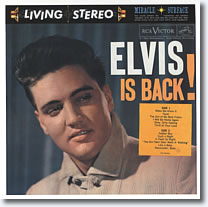 |
|---|
Elvis Is Back LP 1960. |
April 8, Again RCA has rushed the session tapes to the pressing plant, and just four days after the session the LP, Elvis Is Back, is shipped. It's gatefold album of army snapshots has been printed in advance, and the titles of the subsequently recorded songs appear on a sticker on the front cover.
Elvis Is Back represents a peak in Elvis' career, when his maturity and confidence led to a control and focus in his music. Like the pre-army Elvis recordings, this album offered an eclectic collection of musical genres, from a sentimental duet with Charlie Hodge called 'I Will Be Home Again' to the gritty 'Reconsider Baby' with a bluesy sax solo by Boots Randolph. Once again, Elvis' talent for unifying disparate styles of music resulted in an innovative and successful album, and it reached No. 2 on the charts.
Not all the songs that Elvis recorded in Nashville were included on the Elvis Is Back album. RCA held back for later release two of his highly acclaimed ballads: 'It's Now or Never' and 'Are You Lonesome Tonight?' along with the follow-up 'Surrender'. The melancholy tune 'Are You Lonesome Tonight?' was a clear departure from the kind of music that Elvis sang before he went into the army.
In the 1920s, Al Jolson had made this song popular, but Elvis was probably more familiar with a 1959 version of the song that was recorded by pop singer Jaye P. Morgan. She had borrowed her arrangement from a 1950 rendition by the Blue Baron Orchestra. It was Colonel Parker 
 who urged Elvis to record 'Are You Lonesome Tonight?' even though it was unusual for him to interfere with Elvis' choice of music. The song perfectly suited Elvis' new image as a mainstream pop singer.
It's Now Or Never
Who could have guessed that 'It's Now or Never', a reworked version of the 1901 Italian opera-style classic 'O Sole Mio', would become the King of Rock 'n' Roll's biggest-selling single? But then, in 1956, when Elvis was skewered by most newspapers in the country for thrusting his hips to the bluesy beat of 'Hound Dog', no one would have known that he would become a press favorite in just four years.
By quietly serving his country in the army from 1958 to 1960, Elvis had won the hearts and minds of the mainstream press and general public'. It's Now or Never' received airplay on conservative radio stations that previously wouldn't have touched a Presley record, thus exposing Elvis to a wider, adult audience.
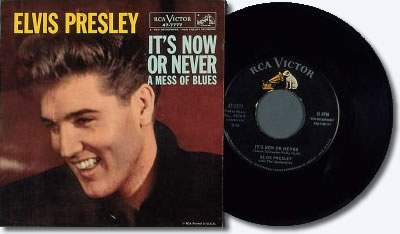
'It's Now or Never' featured a new sound that was an international success for Elvis Presley.
Yet Elvis did not record the song just to gain a broader audience'. O Sole Mio' was written by G. Capurro and Eduardo di Capua at the turn of the twentieth century, but it had been made popular much later by Mario Lanza. Elvis was a fan of Lanza and undoubtedly heard the opera singer's recording, but he had also heard the English version 'There's No Tomorrow' by Tony Martin.
While still in the army, Elvis asked his music publisher, Freddie Bienstock of Hill and Range, to find someone to write new lyrics for the song. The only songwriters available at Hill and Range to do it were Aaron Schroeder and Wally Gold, who jumped at the chance because they knew the royalties on an Elvis Presley song would be enormous. They composed the lyrics in less than 30 minutes. A singer named David Hill (aka David Hess) recorded the demo with a cha-cha arrangement, and Elvis loved it. He was challenged by its operatic style and attracted to its drama. 'It's Now or Never' charted for 20 weeks, holding the No. 1 spot in the U. S. A. for five weeks. Worldwide sales of the tune, according to The Guinness Book, eventually exceeded 20 million copies.
April 21, Elvis begins filming video and recording audio for his first post-Army movie, his fifth film, 'GI Blues', for Paramount. This is the third of nine Elvis films to be produced (not consecutively) by Hal Wallis. 'GI Blues' co-stars dancer/actress Juliet Prowse. Director Norman Taurog would end up working with Elvis on several other films throughout his acting career.
Elvis begins filming and recording for his first post-army movie, his fifth film, GI Blues for Paramount, the first of nine to be produced (not consecutively) by Hal Wallis'.
Elvis Presley : The G. I. Blues Recording Sessions : 1960
April 27, 1960 RCA Studio's - Hollywood, California
Shoppin' Around WPA5 2542-11
Didja' Ever L2PB 3686-02
Doin' The Best I Can L2PB 3688-13
G. I. Blues ____-07
G. I. Blues (Work Part) ____-10
G. I. Blues (Composite) L2PB 3682-SP
Frankfurt Special (Fast Tempo) WPA5 2543-13
Tonight Is So Right For Love L2PB 3678-11
April 28, 1960 RCA Studio's - Hollywood, California
Big Boots (Fast Tempo) WPA5 2514-07
Big Boots (Slow Tempo) L2PB 3685-04
What's She Really Like ____-19
What's She Really Like (Insert) ____-22
What's She Really Like (Composite) L2PB 3679-SP
Blue Suede Shoes L2PB 3687-01
Wooden Heart L2PB 3681-04
Pocketful Of Rainbows WPA5 2544-28
May 6, 1960 Radio Recorders - Hollywood, California
Big Boots (Medium Tempo) WPA5 2545-02
Shoppin' Around L2PB 3684-07
Pocketful Of Rainbows L2PB 3683-02
Frankfurt Special (Medium Tempo) L2PB 3680-10
Tonight's All Right For Love WPA1 8124-11
Tonight's All Right For Love (Insert) ____-02
Tonight's All Right For Love (Composite) L2PB 3975-SP
Big Boots (Slow Tempo 2) ____-06
Big Boots (Slow Tempo - Insert) ____-04
Big Boots (Slow Tempo - Composite) L2PB 3685-SP
Tonight's All Right For Love (Music & Chorus) WPA1 8125-05
On May 12, The Frank Sinatra-Timex Special, also known as Welcome Home Elvis is broadcast on the ABC network from 9. 30 to 10. 30 pm and attracts phenomenal ratings, giving ABC-TV a 41. 5 share for that evening. Elvis was paid a staggering $125,000 for a total of six minutes on the air.
Sammy Davis, Jr. , Peter Lawford, and Joey Bishop, members of Sinatra's famed 'Rat Pack', also appeared on the television special. In addition, the cast included Sinatra's daughter Nancy Sinatra, whom the gossip columns had recently linked with Elvis and would co-star with Elvis in the movie Speedway in 1968. Elvis sang his two latest hits, then later in the show he joined Sinatra for a short duet.
Dressed in a conservative but stylish tuxedo, the former teen idol sang Sinatra's 'Witchcraft', while Sinatra crooned Elvis' 'Love Me Tender'. His choice of clothes, shorter hairstyle, and connections with the Rat Pack indicated that Elvis' career was taking a new direction. When Elvis and Sinatra sang each other's songs, it was as though Sinatra was passing on his position as pop idol to the next generation: The Voice, as Sinatra was known in the 1940s, was making way for the King.
In Ed Sullivan's syndicated newspaper column in the New York Daily News, May 1960, the crusty show business luminary spoke harshly of Elvis' appearance on the The Frank Sinatra-Timex Special.
Lingering bitterness over his dealings with Colonel Parker crept into his account. Sullivan blasted Parker for allowing Elvis to sing only two songs in the special, stating, 'Col. Tom, using the logic of a farmer, is a firm believer in not giving a hungry horse a bale of hay'. Sullivan seemed to forget that it was Sinatra's special, not Elvis', and there were four other guests to showcase as well. Some jabs at how Elvis looked rounded out the column as Sullivan noted that the young singer, 'minus his sideburns, has substituted what the ladies probably would call a 'high hair-do'. His hair is so high in front that it looks like a ski jump'.
The King & Queen of Thailand visit the set with Juliet Prowse sat far right.
July 3, Vernon Presley marries divorcee and mother of three sons, Davada (Dee) Stanley, an American whom he met Germany, where she had been stationed with her military husband. They live at Graceland briefly, then move to a home nearby.
July 8, Elvis takes a spin around McKellar Lake in his new $2000 16-foot boat to water ski boat.
He and four chums were trying it out yester-day afternoon when yours truly arrived on the scene.
July 11, Rock and roll king Elvis Presley hugged singer Anita Wood close early yesterday on a clinging ride called 'The Rocket' at the Fairgrounds Amusement Park in an after-midnight fun spree. Elvis rented the park from 1 a. m. to 5 a. m. and invited about 75 friends to help him kick up his heels.
It's Now Or Never / A Messof Blues : Pick Of The Week : July 16, 1960
Bobby Darin and George Burns : July 26, 1960
August / September, Elvis records and films for his sixth movie, Flaming Star, a drama with limited music. Elvis plays the son of a white father and a Native American mother, torn between the two cultures in the 1800's.
The film co-stars Barbara Eden.
August 8, 1960 Radio Recorders - Hollywood, California
Black Star WPA5 2502-13
Black Star (Ending) ____-05
Black Star (Composite) ____-SP
Black Star (End Title Version) WPA5 2510-06
Summer Kisses Winter Tears M2PB 1986-20
Britches (Track) ____-01
Britches (Vocal Overdub) ____-07
Britches (Vocal Overdub - Insert) ____-01
Britches (Composite) SPA3 6744-SP
A Cane & A High Starched Collar ____-06
A Cane & A High Starched Collar (Insert) ____-06
A Cane & A High Starched Collar (Composite) SPA3 6743-SP
Summer Kisses Winter Tears (Movie Version - Track) ____-01
Summer Kisses Winter Tears (Movie Version - Vocal Overdub) ____-
August 11, 1960 Radio Recorders - Hollywood, California
Summer Kisses Winter Tears (Movie Version - Overdub) WPA5 2546-01
Elvis Presley and Juliet Prowse : September 12, 1960
There is a special screening of G. I. Blues, attended by both Elvis and Juliet Prowse.
October 7, 1960 Radio Recorders - Hollywood, California
Flaming Star M2PB 1987-06
Flaming Star (End Title Version) WPA5 2547-SP
October 16, Elvis breaks his finger playing touch football at Graceland. Elvis was first treated first at Campbell Clinic, where doctors decided to transfer him to the hospital because they didn't have enough space to accommodate the anticipated large number of visitors. His touch football teammates and Anita Wood, disk jockey and Elvis' frequent companion when he is in Memphis, accompanied him to the hospital.
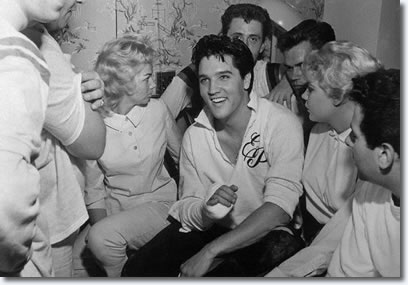
Elvis breaks his finger playing touch football at Graceland, Elvis visits a hospital and goes home
after spending one night, declaring 'I Don't Have Any Business in a Hospital'.
Elvis spends one night in Hospital, declaring 'I don't have any business in a Hospital' and checking out the following morning. Elvis said, 'I don't mind hospitals - this one is really fine - but I don't have any business here. Things like this happen every day. I'm ready to get out of here'. To prove his point he accommodated a student nurse by signing his autograph with his right hand - the one on which the little finger was broken.
Explaining how he came to break his finger, Elvis said 'I got my man, too - and he was just a step or two away from a touchdown. I dived for him, see, and after tagging him my hand landed in some mud and buried up in it'.
'At first I didn't notice it - it didn't hurt me at all - until one of the fellows told me the little finger was bent all the way over the other fingers'. No, it won't affect my strumming a guitar.
I don't know how long I'll have to wear the cast - just a few days, I think'.
Elvis was dressed and ready to leave the hospital but his doctors were wanting him to stay another 24 hours. Elvis himself was more concerned about a slight cold and a sore throat he had today.
'My ice pack melted and the water spilled on me somehow' he said'. I'm also still groggy from the sodium pentothal they used when they set my finger. It sure knocked me out'.
Through out the night and morning, a steady procession of registered nurses, student nurses and nurses aides - young and old - filed into Elvis' room to take his temperature, check his pulse, give him a hypo to put him to sleep, ask what he wanted for breakfast - and ask for his autograph
The hospital posted a guard at the door to keep other visitors out.
The rock'n'roll king had a hospital breakfast of oat-meal and bananas while he waited for his doctor's word on whether he could be discharged. Elvis was discharged at 11:30 a. m.
The soundtrack album for 'GI Blues' enters the Billboard album chart and soon goes to #1. It remains #1 for 10 weeks and stays on the chart for 111 weeks. It is to be the most successful album of Elvis' entire career on the Billboard charts. ('GI Blues' was the most successful album on the music charts. However, 'Blue Hawaii' was the biggest selling album during Elvis' life, selling 2 million copies in the first 12 months. )
October 24, Elvis accepts the Man of the Year Award 1960 from the Tau Kappa Epsilon fraternity at Arkansas State College.
October 26, Elvis Presley at the Fairgrounds Amusement Park Memphis
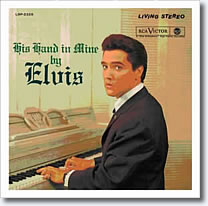 |
|---|
His Hand In Mine LP 1960. |
His Hand In Mine Sessions - October 1960
October 30, 1960 RCA Studio B - Nashville, Tennessee
Milky White Way L2WW 0373-07
His Hand In Mine L2WW 0374-SP
I Believe In The Man In The Sky L2WW 0375-04
He Knows Just What I Need L2WW 0376-10
Surrender L2WW 0377-04
Surrender (Work Part) ____-08
Surrender (Composite) L2WW 0377-SP
Mansion Over The Hilltop L2WW 0378-03
October 31, 1960 RCA Studio B - Nashville, Tennessee
In My Father's House L2WW 0379-08
In My Father's House (Composite) L2WW 0379-SP
Joshua Fit The Battle L2WW 0380-04
Swing Down Sweet Chariot L2WW 0381-04
I'm Gonna Walk Dem Golden Stairs L2WW 0382-01
If We Never Meet Again L2WW 0383-01
Known Only to Him L2WW 0384-05
Crying In The Chapel L2WW 0385-03
Working On The Building L2WW 5001-05
November, Elvis begins recording and filming for his seventh film, 'Wild in the Country', which will be completed in January. 'GI Blues' opens nationally on November 23 to warm reviews and big box office sales, making it one of the best Elvis movies of his post-Army career. It was #2 the first week and for the year on Variety's list. By 1969, Variety reports it had grossed 4. 3 million, equal to 'The African Q'.
November 7, 1960 Radio Recorders - Hollywood, California
Lonely Man (Record Version) L2PB 5381-13
Lonely Man (Solo) WPA5 2504-04
In My Way (Solo) L2PB 5384-08
Wild In The Country L2PB 5383-19
Forget Me Never (Solo) L2PB 5385-03
November 8, 1960 Radio Recorders - Hollywood, California
I Slipped I Stumbled I Fell (High Key) L2PB 5382-13
I Slipped I Stumbled I Fell (Low Key) WPA5 2548-18
November 1960 Radio Recorders - Hollywood, California
Wild In The Country (Overdub) L2PB 5383
November 23, GI Blues opens nationally to warm reviews and big box office sales and is among the fifteen top-grossing films of the year. It is a light comedy melodrama with lots of singing by Elvis.
December 22, 'Flaming Star' opens nationally to warm reviews, but unlike 'GI Blues', this dramatic film with little singing, does not set the box office on fire. It was #12 for the week. Elvis does however earn recognition from a tribal council for his positive portrayal of a Native American in this racially charged drama. The film is banned in South Africa due to its interracial theme.
December 25, Elvis spends his first Christmas at Graceland since the death of his mother.
Elvis Presley 1961
January 6, 1961, there is a birthday party for Elvis on the set of Wild In The Country.
The Girl Who Crashed Elvis' Movie Studio
February 25, Elvis appears at a luncheon in his honor in Memphis. His most recent awards are on display for the press and guests. Following a press conference, Elvis performs an afternoon and evening show at Ellis Auditorium to benefit around 38 Memphis-area charities. Other than the Sinatra television show, these shows are the only times Elvis has performed live since his Army discharge.
'Elvis Presley Day' is proclaimed by Tennessee Governor Buford Ellington. Every year after this, Elvis donates money to a list of Memphis-area charities, eventually reaching 50 or more, usually around Christmas time. Within a few years, to show their appreciation, the city gives him a massive plaque listing 50 charities.
Elvis Presley : February 25, 1961 : Elvis Presley Day Proclaimed
Every year after this, Elvis donates money to a list of Memphis-area charities, eventually reaching fifty or more, usually around Christmas time. Within a few years, to show their appreciation the city gives him a massive plaque listing fifty charities Then, Elvis performs one afternoon show and one evening show at Ellis Auditorium to benefit around thirty-eight Memphis-area charities. Other than the Sinatra television show, these shows are, so far, Elvis' only live performances since his army discharge.
Tennessee Governor Buford Ellington and Memphis mayor Henry Loeb both declare February 25, 1961 'Elvis Presley Day'. The Governor makes Elvis an honorary Colonel by giving him the title 'Colonel, Aide de Camp on the Governor's Staff'. At a special luncheon at the Hotel Claridge, Elvis is presented by RCA with a diamond-studded watch to honor record sales of more than 75 million. Elvis then gave a press conference, [Sam Phillips asks why Sun Records gets so little recognition for Elvis' success, reminding everyone that 'RCA wouldn't have him if it wasn't for Phillips] and follows with two concerts with the proceeds ($47,823) being distributed among twenty-six charities. View photos and  listen to the press conference.
Memphis Benefit shows. Feb. 25
25 February. Memphis, TN. Ellis Auditorium (2 shows)March 8, 1961, Elvis addresses the Tennessee State Legislature, Nashville, Tennessee and accepts the title of 'Honorary Colonel'.
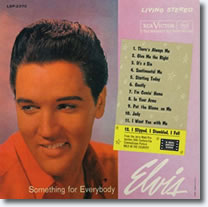 |
|---|
Something For Everybody LP 1961. |
March 12, 1961 RCA Studio B - Nashville, Tennessee
I'm Coming Home M2WW 0567-07
Gently M2WW 0568-05
In Your Arms M2WW 0569-02
Give Me The Right M2WW 0570-04
I Feel So Bad M2WW 0571-02
It's A Sin M2WW 0572-04
I Want You With Me M2WW 0573-02
There's Always Me M2WW 0574-10
March 13, 1961 RCA Studio B - Nashville, Tennessee
Starting Today M2WW 0575-03
Sentimental Me M2WW 0576-02
Judy M2WW 0577-08
Put The Blame On Me M2WW 0578-05
Elvis Presley and Blue Hawaii
 |
|---|
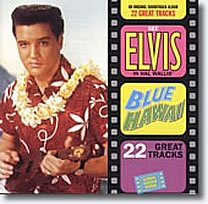
Blue Hawaii LP 1961. |
On March 14, 1961, Elvis and assorted friends, assistants, and bodyguards flew to Los Angeles so he could begin production on his next film, Blue Hawaii. Upon his arrival, he spent a few fun-filled days with friends Juliet Prowse, Joan Blackman, and Pat Fackethal, a real-life stewardess selected to play a bit part as a stewardess in the film. Afterward, he buckled down to record the songs that would comprise the soundtrack. Elvis recorded the tunes for the modestly budgeted musical comedy in Hollywood as opposed to Nashville, where much of his non soundtrack music was produced.
While this was business as usual for Presley that year, in retrospect it marks a juncture in his career. His management team, made up of Colonel Parker, Elvis, Hal Wallis, and Abe Lastfogel, Elvis' William Morris agent, had already determined that movies should be the focus of his career, but Blue Hawaii would narrow that focus further. Because it was Elvis' highest-grossing film at the box office, it became the model for the type of musical comedy associated with him during the 1960s. As the decade progressed, all other Elvis recordings took a backseat to the music for the movies.
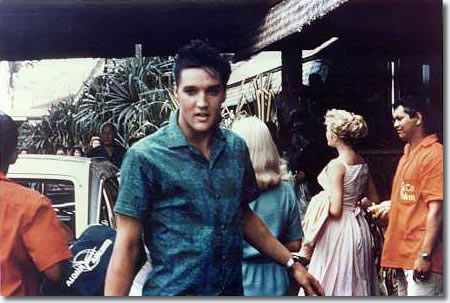
1961: Elvis at the Coco Palms Resort.
The soundtrack to Blue Hawaii may have been miles away from rock 'n' roll or rhythm-and-blues, but it gave Elvis the song with which he would close most of his 1970s concerts: 'Can't Help Falling in Love'. Recorded at Radio Recorders in Hollywood in 1961, Blue Hawaii featured 14 songs, more than any other Elvis soundtrack.
Most of the 14 songs on the album are pop-style tunes. Some of these were not written for the film but had been recorded and released previously, including 'Moonlight Swim', 'Blue Hawaii', and 'Hawaiian Wedding Song', 'Aloha Oe' was composed by Queen Liliuokalani of Hawaii in 1878. The title tune and the song 'Aloha Oe' had been recorded in the 1930s by Bing Crosby during a craze for the allure of the tropical isles.
Blue Hawaii became Elvis' biggest-selling movie soundtrack. It topped the Billboard albums chart two months after its October 1961 release. It was the No. 1 album in the country for 20 weeks, which set a record for a rock performer or group that lasted until 1977 when Fleetwood Mac's Rumors broke it. Blue Hawaii remained on the albums chart for 79 weeks and was awarded double platinum status by the RIAA in March 1992.
After the soundtrack was recorded, Elvis and his entourage flew to Honolulu for a month's worth of location shooting. Hawaiian fans were as enthusiastic as those on the mainland, persistently trying to get into Elvis' hotel to see their idol. A few pretended to be mail messengers with special delivery packages that only Elvis could sign for; others managed to climb the fire escape.
The exotic locale was a key element in the promotion of Blue Hawaii and in its success. The scenery provided more than just beautiful cinematography. As a tropical paradise, Hawaii was the perfect setting for romance, and it represented an escape from the mundane everyday world of most viewers.
Even the title reinforced the locale, reminding audiences of the beautiful paradise that had become America's 50th state amid much fanfare in 1960.
The romance and escape that went with these settings became an essential ingredient in the formula for Elvis' later movies. He returned to Hawaii to make (All ) Girls! Girls! Girls!and Paradise, Hawaiian Style and went to Florida to make Follow That Dream; Girl Happy; Easy Come, Easy Go; and Clambake. The movies Fun in Acapulco, It Happened at the World's Fair, and Viva Las Vegas provide action in obvious places. The films Harum Scarum and Double Trouble offer fabulous adventures in distant countries.
Any viewer familiar with Elvis' movies recognizes the prevalence of unique and exotic locations, but not all realize the extent to which these settings affect the whole film. For example, Elvis' characters were independent spirits who worked as race-car drivers, pilots, tour guides, entertainers, or boat captains -- unusual occupations, to say the least. Yet they seem almost appropriate given the exotic settings. In a way, the settings determined the occupations of Elvis' characters, which indirectly helped define them as free souls who reject the conventional, nine-to-five lifestyle.
In addition, exotic and vacation settings convey the idea of slipping off to paradise for romantic escapades. For decades, travel brochures have used this very notion to entice tourists to distant lands.
As soon as viewers recognized the setting of an Elvis film as exotic, unique, or a haven for fun-seeking vacationers, the stage was set for romance.
And romance was the main attraction in an Elvis Presley movie. The plot may center around a quest or an adventure, but it parallels the pursuit of a beautiful woman by Elvis' carefree hero. The story concludes when the goal is completed or the quest fulfilled, which is represented by the union of Elvis' character with his leading lady. The complete closure of the film in terms of fulfilling the goal and winning the girl is generally indicated by the final musical number in which the couple are united via song and/or dance.
March 21, 1961 Radio Recorders - Hollywood, California
Hawaiian Sunset M2PB 2994-SP
Aloha Oe (Section 2) ____-SP
Ku-U-I-Po M2PB 2991-09
No More M2PB 2987-SP
Slicin' Sand M2PB 2993-19
March 22, 1961 Radio Recorders - Hollywood, California
Blue Hawaii M2PB 2984-07
Ito Eats M2PB 2992-09
Hawaiian Wedding Song M2PB 3015-02
Island Of Love M2PB 3000-13
Steppin' Out Of Line M2PB 3038-17
Steppin' Out Of Line (Movie Version) WPA5 2549-SP
Almost Always True M2PB 2985-08
March 23, 1961 Radio Recorders - Hollywood, California
Aloha Oe (Composite) M2PB 2986-SP
Can't Help Falling In Love (Movie Version) WPA5 2550-23
Can't Help Falling In Love M2PB 2988-29
Beach Boy Blues M2PB 2995-02
Beach Boy Blues (Movie Version) WPA5 2585-03
Rock A Hula Baby M2PB 2989-05
 |
|---|
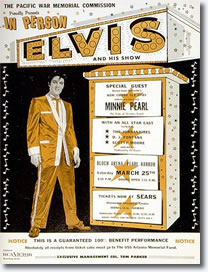
Poster for the Pearl Harbor Benefit |
March 25, Elvis performed live at the Bloch Arena at Pearl Harbor, Hawaii. The show was a fundraiser to build a memorial for the USS Arizona, the largest of the eight battleships that had been sunk on December 7, 1941, during the surprise Japanese air attack on Pearl Harbor.
Ticket prices for Elvis' performance ranged from $3 to $10 a seat, with 100 ringside seats reserved for people who donated $100.
Pearl Harbor Benefit. Mar. 25, 1961
25 March. Honolulu, HI. Bloch Arena
Elvis and Colonel Parker bought 50 of these special seats and donated them to patients from Tripler Hospital in Hawaii. Elvis' benefit raised more than $52,000 for the memorial fund. On March 30, the Hawaii House of Representatives passed Special Resolution 105 thanking Elvis and the Colonel.
The benefit for the Arizona memorial could be considered a good career move in that it helped Elvis become more acceptable to an adult audience, but his career was not the only reason Elvis agreed to do the concert. He had a sensitive, generous nature, and throughout his entire life, Elvis gave freely to charities and other worthy causes, whether he received publicity for it or not.
Five years after this benefit, while in Hawaii filming Paradise, Hawaiian Style, Elvis visited the completed memorial and placed a wreath there. Photographers and reporters rushed in to record the event, but Elvis sent them away. He did not want his visit to the memorial to become a publicity stunt.
50th anniversary of Elvis' U. S. S. Arizona Benefit concert, March 25, 1961
Inside Follow That Dream : Fans Remember : On The Set With Elvis
In 1961 Elvis made the movie 'Follow That Dream' in Yankeetown, Florida. In the weeks before filming began, the moviemakers had converted the tip of a marshy little island into a slice of paradise for Elvis Presley . . . Two 17-year-old high school students, Johnny Jones and his twin brother Tommy, were hired to build the beach. 'Every day, they would pick us up in a white limousine to shovel dirt. Then the limousine would take us home.
March 28, 1961 Paramount Scoring Stage - Hollywood, California
Moonlight Swim M2PB 2990
June 22, 'Wild in the Country', co-starring Hope Lange, Millie Perkins and Tuesday Weld, opens nationally to mixed reviews. Like 'Flaming Star', it is a melodrama with limited singing by Elvis, and not one of his most successful motion pictures. Also in June, the album 'Something For Everybody' is shipped. It hits the charts in July, staying for 25 weeks and spending three of those weeks at #1.
June 25, 1961 RCA Studio B - Nashville, Tennessee
Kiss Me Quick M2WW 0857-12
That's Someone You Never Forget M2WW 0858-08
June 26, 1961 RCA Studio B - Nashville, Tennessee
I'm Yours M2WW 0859-06
I'm Yours (Work Part) ____-02
I'm Yours (Composite) M2WW 0859-SP
I'm Yours (Harmony Vocal Overdub) M2WW 0859-SP
His Latest Flame M2WW 0860-08
Little Sister M2WW 0861-04
July 1, Elvis at Red West's Wedding
July 2, 1961 RCA Studio B - Nashville, Tessessee
Angel M2WW 0873-07
Follow That Dream M2WW 0874-06
What A Wonderful Life M2WW 0875-07
I'm Not The Marrying Kind M2WW 0876-08
A Whistling Tune M2WW 0877-04
A Whistling Tune (Overdub) ____-NA
Sound Advice M2WW 0878-06
October 15, 1961 RCA Studio B - Nashville, Tennessee
For The Millionth & The Last Time M2WW 1002-12
Good Luck Charm M2WW 1003-04
Anything That's Part Of You M2WW 1004-10
October 16, 1961 RCA Studio B - Nashville, Tennessee
I Met Her Today M2WW 1005-18
Night Rider M2WW 1006-03
October 26, 1961 Radio Recorders - Hollywood, California
King Of The Whole Wide World WPA5 2551-31
A Whistling Tune N2PB 3136-SP
Home Is Where The Heart Is N2PB 3134-21
Riding The Rainbow ____-09
Riding The Rainbow ____-07
Riding The Rainbow (Composite) N2PB 3133-SP
October 27, 1961 Radio Recorders - Hollywood, California
I Got Lucky (Alternate Master) ____-06
I Got Lucky N2PB 3135-02
This Is Living N2PB 3132-10
King Of The Whole Wide World N2PB 3131-04
The soundtrack album for 'Blue Hawaii' enters the Billboard chart for a year-and-a-half run, staying at #1 for 20 weeks, second only to 'GI Blues' as the biggest album of Elvis' career on the Billboard charts. It also yields a #2 single destined to become an Elvis classic, 'Can't Help Falling in Love'.
Non-movie-related recordings and hit records have continued through this period, with 'Good Luck Charm' hitting #1 in 1962, his last number one pop hit until 'Suspicious Minds' in 1969.
November 22, 'Blue Hawaii' opens nationally to warm reviews. The film hits #18 on the box office charts for 1961 and #14 for 1962. It earns recognition as one of the Best Elvis movies, and is top-grossing film of his career thus far. Its characteristics of a non-cerebral plot, lavish scenery, lots of songs by Elvis, and lots of pretty girls, become the basis for the 'Presley formula' movies of the sixties.
December 25, Elvis and Priscilla spend Christmas in Las Vegas. Other than the Elvis Army years, this is the only Christmas Elvis will spend away from Graceland. He will spend from December 22 to January 29 in Las Vegas.
Elvis wants to avoid Graceland while Vernon and his new wife, Dee are staying at Graceland.
December 28, Vernon and Dee Presley move into their new home qt 3650 Hermatige Drive.
Elvis Presley 1962
Elvis celebrates his twenty seventh birthday in Las Vegas : January 8, 1962.
January, 26, 1962 : Elvis Presley with Las Vegas Entertainment Columnist Forest Duke at the opening of Johnny Ray's show at the Dunes Hotel. Sonny West is behind them.
Elvis Presley and Johnnie Ray : January 26, 1962 : Backstage after Ray's Opening at the Dunes Hotel.
March 9, Elvis went backstage at The Auditorium on the night of to say hello to some of his friends in the Holiday on Ice cast, and skating star Dorothy Goos promptly put him to work holding yarn. Elvis had visited Holiday on Ice people here during their last three annual visits.
March 12, Elvis Purchases a 1962 Dodge House Car complete with air conditioning, a double bed, two bunks and a kitchen. He plans to have George Barris customize it and to use it to drive back and forth to California.
March 18, 1962 RCA Studio B - Nashville, Tennessee
Something Blue N2WW 0685-07
Gonna Get Back Home Somehow N2WW 0686-07
Easy Question N2WW 0687-05
Fountain Of Love N2WW 0688-10
Just For Old Times Sake N2WW 0689-05
Night Rider N2WW 0690-05
You'll Be Gone N2WW 0691-03
March 19, 1962 RCA Studio B - Nashville, Tennessee
I Feel That I've Known You Forever N2WW 0692-05
Just Tell Her Jim Said Hello N2WW 0693-06
Suspicion N2WW 0694-05
She's Not You N2ww 0695-05
She's Not You (work Part) ____-03
She's Not You (Composite) N2WW 0695-sp
March 26, 1962 Radio Recorders - Hollywood, California
I Don't Want To N2PB 3275-03
We're Coming In Loaded N2PB 3288-06
Thanks To The Rolling Sea N2PB 3281-05
March 27, 1962 Radio Recorders - Hollywood, California
Where Do You Come From N2PB 3274-14
Girls! Girls! Girls! N2PB 3272-03
Return To Sender N2PB 3279-02
Because Of Love N2PB 3280-06
The Walls Have Ears N2PB 3283-12
The Walls Have Ears (Movie Version) ____-01
Song Of The Shrimp N2PB 3282-06
A Boy Like Me A Girl Like You N2PB 3277-05
March 28, 1962 Radio Recorders - Hollywood, California
Mama WPA1 8121-10
Earth Boy N2PB 3278-09
Earth Boy (Movie Version) ____-SP
Earth Boy (Movie Version - Vocal Overdub) ____-SP
Dainty Little Moonbeams (End Title - Part 1) WPA5 2505-06
Girls! Girls! Girls!(End Title - Part 2) WPA5 2506-15
Girls! Girls! Girls! (End Title - Composite) ____-SP
I Don't Want To Be Tied N2PB 3273-08
I Don't Want To Be Tied (Movie Version) ____-SP
Plantation Rock NPA5 5824-SP
May 2, 1962 Radio Recorders - Hollywood, California
Mama (Composite) WPA1 8122-SP
May 23, 1962 Radio Recorders - Hollywood, California
We'll Be Together N2PB 3276-11
May 23, Follow That Dream opens nationally.
June 17, For the first time since leaving Germany in 1960, Elvis is reunited with Priscilla Beaulieu. She stays for two weeks at the home of Presley friend and custom car designer George Barris after endless assurances from Elvis to her parents that she will be respected and well cared for.
June 19, After two days with Barris, Priscilla moves into Elvis' L. A. Home on Bellagio Drive anyway.
June 20, Elvis, Priscilla, and the Memphis Mafia head to the Sahara in Vegas.
July 1, Priscilla returns to Germany.
July 12, Elvis purchases land directly across Highway 51 from Graceland, using the mansion itself as collateral.
July 29, Kid Galahad opens nationally.
August 6, Longtime girlfriend Anita Wood -- who has been staying at the Graceland mansion since Elvis' return from the Army -- overhears the singer talking to his father about the difficulty of choosing between Anita and Priscilla. She immediately returns to her hometown of Jackson, TN, telling the Memphis Press-Scimitar that Elvis is not ready to settle down. Read our Interview with Anita Wood for the full story.
August 28, Elvis records and films for his 12th motion picture, 'It Happened at the World's Fair'. Shooting is done in Hollywood and on location at the World's Fair in Seattle.
August 29, 'Kid Galahad' opens nationally and does relatively well with a brief stay in the top 10 on the box office chart.
August 30, 1962 Radio Recorders - Hollywood, California
Happy Ending PPA3 2717-08
Happy Ending (Movie Version) PPA3 2717-09
Relax PPA3 2726-13
September 22, 1962 Radio Recorders - Hollywood, California
I'm Falling In Love Tonight PPA3 2719-08
They Remind Me Too Much Of You PPA3 2725-09
Cotton Candy Land PPA3 2720-05
A World Of Our Own PPA3 2721-01
How Would You Like To Be PPA3 2722-06
One Broken Heart For Sale (Movie Version) WPA5 2512-01
One Broken Heart For Sale PPA3 2724-05
Beyond The Bend PPA3 2723-04
Take Me To The Fair PPA3 2718-08
October 16, 1962 MGM Sound Stage - Hollywood, California
Take Me To The Fair (Movie Version) WPA5 2552
August 31, California clothier to the stars Sy Devore reveals in an interview that the King does not wear underwear. Elvis is upset but eventually returns to the store -- in underwear.
October 21, Girls Girls Girls opens and lands at on the #6 Variety chart and #31 for the year. Soundtrack album goes to #3 and the single 'Return to Sender' hits #2. For 1962, Elvis' movies at the box office are 'Blue Hawaii' at #14, 'Girls! Girls! Girls!' at #31 and 'Kid Galahad' at #37.
November 29, Elvis returns to Memphis and is greeted with bad news: his first nationwide tour in three years has fallen through, the result of an inability for the Colonel and RCA to come to terms on the details.
The 43-date tour would have netted Elvis one million dollars.
December 19, Having apparently made his decision, Elvis meets Priscilla at his father's house in Memphis, where she has driven in from New York City with father Vernon and stepmother Dee. Priscilla is nervous, and Elvis prescribes some sleeping pills which leave her asleep for the better part of two days.
December 25, At a private Graceland Christmas party, Elvis presents Priscilla with a toy poodle, which she promptly names Honey. Her gift to Elvis is a wooden cigar box that plays his recent hit 'Surrender'.
December 31, After fireworks at Graceland, New Year's Eve 1962 is spent at another private party.
held this time at Memphis' Manhattan Club.
Elvis Presley 1963
January 21-March 22, Elvis records and films for his 13th film, 'Fun in Acapulco'. Priscilla moves to Memphis in early March 1963 while Elvis is in Hollywood filming. She graduates from high school on May 29, 1963, five days after turning 18 years old.
January 22, 1963 Radio Recorders - Hollywood, California
Bossa Nova Baby PPA3 4431-11
I Think I'm Gonna Like It Here PPA3 4430-SP
Mexico PPA3 4425-05
Mexico (Track) ____-03
Mexico (Vocal Overdub) ____-NA
The Bullfighter Was A Lady PPA3 4428-SP
Marguerita PPA3 4427-08
Vino Dinero Y Amor PPA3 4424-05
January 23, 1963 Radio Recorders - Hollywood, California
No Room To Rhumba In A Sports Car PPA3 4429-01
Fun In Acapulco PPA3 4423-01
El Toro PPA3 4426-SP
I Think I'm Gonna Like It Here (Remake) WPA5 2540-SP
The Bullfighter Was A Lady (Remake) WPA5 2541-17
You Can't Say No In Acapulco PPA3 4432-05
Malaguena (Track) ____-05
Guadalajara (Track) ____-SP
February 27, 1963 Radio Recorders - Hollywood, California
Guadalajara (Vocal Overdub) PPA3 4433-SP
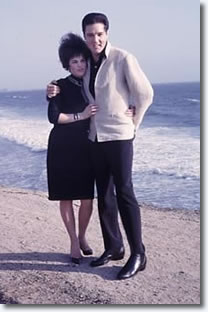 |
|---|
Elvis & Priscilla 1963 |
March 2, Priscilla arrives in Los Angeles with her father to meet Elvis and conclude arrangements permitting Priscilla to live in Memphis with Vernon and Dee and complete her senior year at Immaculate Conception High School.
April 1, Elvis buys Priscilla a red Corvair so she can drive herself to school.
April 1963, It Happened at the World's Fair opens nationally and does relatively well at the box office, though its plot is the most frivolous of any Elvis film so far. The soundtrack album goes top five.
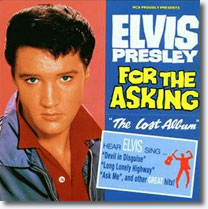
May 26, Elvis goes to RCA's Studio B in Nashville working on what will eventually become 14 recorded masters. The songs are intended to make up an album and a single with 'Devil In Disguise' selected as the A-side. The album however is never released with the songs parceled out over the next few years as singles or soundtrack album 'bonus selections'. (The 'album' was eventually released on CD as 'For The Asking - The Lost Album' in 1990.
Now available on the new FTD release, Elvis Sings Memphis Tennessee.
May 26 1963 RCA Studio B - Nashville, Tennessee
Echoes Of Love PPA4 0290-10
Please Don't Drag That String Around PPA4 0291-06
Devil In Disguise PPA4 0292-06
Never Ending PPA4 0293-03
What Now What Next Where To PPA4 0294-01
 |
|---|
For The Asking CD 1990 |
Witchcraft PPA4 0295-03
Finders Keepers Losers Weepers PPA4 0296-03
Love Me Tonight PPA4 0297-08
May 27 1963 RCA Studio B - Nashville, Tennessee
Memphis Tennessee PPA4 0302-02
Long Lonely Highway (Single Version) PPA4 0303-01
Long Lonely Highway (Record Version) PPA4 0303-02
Ask Me PPA4 0304-02
Western Union PPA4 0305-04
Slowly But Surely PPA4 0306-05
Blue River PPA4 0307-02
Ask Me (Alternate Master) PPA4 0304-06
July 1963, Elvis records the music, then, on location in Las Vegas and in a Hollywood studio, he films for his fourteenth motion picture, Viva Las Vegas, co-starring Ann-Margret.
July 9, 1963 Radio Recorders - Hollywood, California
Night Life WPA1 8023-14
C'mon Everybody (Record Version) RPA3 0389-05
July 10, 1963 Radio Recorders - Hollywood, California
If You Think I Don't Need You RPA3 0387-13
Viva Las Vegas (Tryout) ____-01
I Need Somebody To Lean On RPA3 0386-20
Do The Vega WPA1 8025-07
Santa Lucia (Track) ____-03
Viva Las Vegas RPA3 0234-07
July 11, 1963 Radio Recorders - Hollywood, California
Yellow Rose Of Texas / The Eyes Of Texas WPA1 8024-09
C'mon Everybody (Movie Version) ____-07
The Lady Loves Me (Duet) NPA5 5825-10
You're The Boss (Duet) WPA5 2511-16
Today Tomorrow & Forever (Duet) OPA5 8215-02
Today Tomorrow & Forever (Track) ____-06
Today Tomorrow & Forever (Record Version) RPA3 0388-06
Today Tomorrow & Forever (Track Dubdown) ____-06
Santa Lucia (Vocal Overdub) ____-06
Santa Lucia (Overdub) SPA3 5518
Today Tomorrow & Forever (Movie Version Vocal Overdub) ____10
August 13, 1963 MGM Sound Stage - Hollywood, California
Viva Las Vegas (Movie Version - Intro) ____-01
C'mon Everybody (Movie Version - Overdubs) ____-03
C'mon Everybody (Movie Version - Blues Ending) ____-01
C'mon Everybody (Movie Version - Composite) ____-SP
August 30, 1963 Radio Recorders - Hollywood, California
What'd I Say RPA3 0235-04
September 4, 1963 MGM Sound Stage - Hollywood, California
I Need Somebody To Lean On (Movie Version) ____-01
September 29, 1963 RCA Studio B - Nashville, Tessessee
There's Gold In The Mountains (Track) ____-03
One Boy Two Little Girls (Track) ____-05
Once Is Enough (Track) ____-03
Tender Feeling (Track) ____-02
Kissin' Cousins No. 2 (Track) ____-02
September 30, 1963 RCA Studio B - Nashville, Tessessee
Smokey Mountain Boy (Track) ____-04
Catchin' On Fast (Track) ____-04
Barefoot Ballad (Track) ____-07
Anyone (Track) ____-05
Kissin' Cousins (Track) ____-02
Smokey Mountain Boy (Different Arrangement - Track) ____-03
October 10, 1963 MGM Sound Stage - Hollywood, California
Once Is Enough (Vocal Overdub) RPA3 0222-07
Catchin' On Fast (Vocal Overdub) RPA3 0221-07
Anyone (Vocal Overdub) RPA3 0227-03
Smokey Mountain Boy (Vocal Overdub) RPA3 0224-03
Smokey Mountain Boy (Different Arrangement - V. O ?) ____-NA
There's Gold In The Mountains (Vocal Overdub) RPA3 0226-03
One Boy Two Little Girls (Vocal Overdub) RPA3 0223-02
Kissin' Cousins (Hillbilly Vocal Overdub) ____-01
Kissin' Cousins (Regular Vocal Overdub) ____-02
Kissin' Cousins (Vocal Overdub) RPA3 0218-SP
Barefoot Ballad (Vocal Overdub) ____-02
Barefoot Ballad (Vocal Overdub) ____-04
Barefoot Ballad (Vocal Overdub - Composite) RPA3 0220-SP
Kissin' Cousins No. 2 (Vocal Overdub - Edit) RPA3 0219-04
Tender Feeling (Vocal Overdub) RPA3 0225-01
Late November 1963, Fun in Acapulco opens nationally and quickly goes to number five at the box office.
The soundtrack goes to the top five on the pop chart.
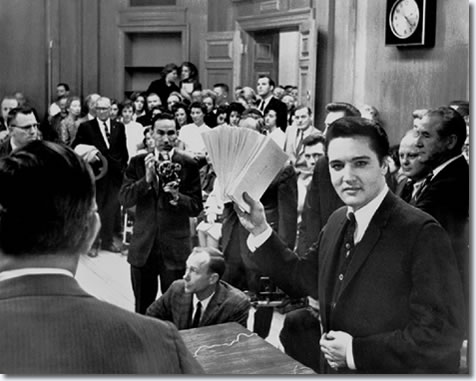
More than 150 people jammed into the mayor's office Tuesday December 17, 1963 to see Elvis Presley hand out Christmas checks totaling $55,000. The checks benefitted 58 Memphis and Mid-South charities. In appreciation, the organizations presented Elvis with a six-foot plaque.
It was warm in the room and when Commmissioner Claude Armour announced Elvis was going to pass out the checks, the singer wiped his brow and said, 'Elvis is going to pass out, period'.
December 25, Elvis and Priscilla spend Christmas at Graceland
Elvis Presley 1964
Elvis purchases the Potomac, former presidential yacht of Franklin Roosevelt, for $55,000 on January 30. He intends to donate it to the March of Dimes for use as a national shrine (FDR suffered from polio, the main disease fought by the March of Dimes). Costs of maintaining the yacht would be prohibitive, so the March of Dimes declines the gift. Elvis attempts to give it to the 7th Coast Guard District Auxiliary in Miami, which also doesn't work out. Finally, on February 13, he presents the yacht as a gift to St. Jude Children's Research Hospital in Memphis for them to use to raise funds as they see fit. The ceremony takes place in Long Beach, California, on February 14, with actor and hospital founder, Danny Thomas, accepting.
During this saga of trying to donate the yacht, the Beatles make their first appearance on 'The Ed Sullivan Show' and Sullivan reads on the air a congratulatory telegram from Elvis and the Colonel. American music and pop culture will soon change dramatically with the 'British invasion' of the sixties, much as it had after Elvis made rock history in the fifties.
Elvis Presley : Arriving at RCA Studio B, Nashville, Tennesee : January 12, 1964
January 12 1964 RCA Studio B : Nashville, Tennessee
Memphis Tennessee RPA4 1004-06
Ask Me RPA4 1005-11
It Hurts Me RPA4 1006-05
After this session Elvis recorded nothing but movie soundtracks, mostly in Hollywood until may 1966. Unsatisfied with his life for complex professional and personal reasons, he did not venture into the Nashville studios to cut any album material. When he did finally decide to record new material, he returned to the studio with new musicians and a new producer, Felton Jarvis.
February 4, 1964 : Elvis' check which he used to pay for the yacht that he donated to St Jude's
March 2, 1964 Radio Recorders - Hollywood, California
Little Egypt RPA3 5270-15
Poison Ivy League RPA3 5272-07
Hard Knocks RPA3 5267-04
It's A Wonderful World RPA3 5268-13
March 3, 1964 Radio Recorders - Hollywood, California
Big Love Big Heartache RPA3 5265-17
One Track Heart RPA3 5271-05
I'm A Roustabout (Roustabout No. 2) ____-NA
It's Carnival Time (Track) ____-02
It's Carnival Time (Movie Version) ____-NA
It's Carnival Time (Vocal Overdub) RPA3 5269-09
Carny Town RPA3 5266-09
There's A Brand New Day On The Horizon RPA3 5274-05
Wheels On My Heels RPA3 5275-07
Little Egypt (Remake) WPA5 2553-21
Little Egypt (Movie Version - Composite) ____-SP
March 6, 'Kissin' Cousins' opens nationally. One of the poorest quality films of his career, it still quickly hits #11 at the box office, then quickly falls. The record hits #6.
April 29, 1964 Radio Recorders - Hollywood, California
Roustabout (Track) ____-11
April 30, Elvis meets Larry Geller and starts his spiritual studying in earnest.
May 14, 1964 Radio Recorders - Hollywood, California
Roustabout (Vocal Overdub) RPA3 5273-17
March 6, Kissin' Cousins opens nationally. One of the poorest quality films of his career, it still quickly hits number eleven at the box office, then quickly falls, and the album goes top ten.
May 17, Viva Las Vegas opens nationally and goes to number eight at the box office
It's one of the better Elvis movies of this period, and the songs are better as well.
June 10, 1964 Radio Recorders - Hollywood, California
Puppet On A String SPA3 2010-11
The Meanest Girl In Town SPA3 2008-13
Girl Happy ____-13
Girl Happy (Insert #1 - Ending) ____-04
Girl Happy (Original Composite) ____-SP
June 11, 1964 Radio Recorders - Hollywood, California
Cross My Heart & Hope To Die SPA3 2007-SP
Spring Fever SPA3 2002-24
Do Not Disturb SPA3 2006-36
I've Got To Find My Baby (Track) ____-02
Fort Lauderdale Chamber Of Commerce (Track) ____-07
June 12, 1964 Radio Recorders - Hollywood, California
Startin' Tonight (Track) ____-03
Do The Clam (Track) ____-05
Wolf Call (Track) ____-08
Girl Happy (End Title) ____-NA
Girl Happy (Composite - Speeded Up) SPA3 2001-SP
Spring Fever (Movie Version) ____-SP
June 15, 1964 Radio Recorders - Hollywood, California
Wolf Call (Vocal Overdub - Edit) SPA3 2005-05
Do The Clam (Vocal Overdub) SPA3 2009-02
Fort Lauderdale Chamber Of Commerce (V. O. - Edit) SPA3 2003-02
Startin' Tonight (Vocal Overdub - Edit) SPA3 2004-04
I've Got To Find My Baby (Vocal Overdub - Edit) SPA3 2011-01
June 17, 'Viva Las Vegas' opens nationally and goes to #14 at the box office. It's one of the better movies from Elvis in the ‘60s and the songs on this record are better as well. By the end of the year, it is #11, outranking The Beatles 'A Hard Day's Night' and becoming Elvis' highest grossing film ever.
September 21, Elvis becomes an official 'Special Deputy Sheriff' for Shelby County.
October 6, Elvis begins shooting his 18th motion picture, 'Tickle Me'. The soundtrack has no new recordings. Instead, previously released non-movie recordings are used, apparently to keep production costs to a minimum. Filming continues until November 24, 1964.
November 11, Roustabout opens nationally and hits #8 at the box office. The soundtrack, which represents some of the best Elvis movie music in a while, goes to #1 on the Billboard pop album chart. Elvis is ranked as the sixth-biggest-money-making star of 1964. The single 'Blue Christmas/Wooden Heart' reach #1 on the Christmas Chart.
December 1964
Col. Parker renegotiates future movie contracts with both United Artists and MGM. The deals, with salary and % of profits, finally reaches his goal for Elvis of $1,000,000 a movie.
December 25, Elvis and Priscilla spend Christmas at Graceland.
December 31, Elvis rents out the Memphian for New Years Eve.
Elvis Presley 1965
January 8, Elvis celebrates his 30th birthday.
February 24, 1965 RCA Studio B - Nashville, Tessessee
Shake That Tambourine SPA3 6752-SP
February 25, 1965 RCA Studio B - Nashville, Tessessee
So Close Yet So Far SPA3 6754-SP
My Desert Serenade SPA3 6761-12
Wisdom Of The Ages SPA3 6760-05
Kismet SPA3 6758-05
Hey Little Girl SPA3 6759-05
February 26, 1965 RCA Studio B - Nashville, Tessessee
Golden Coins SPA3 6753-SP
Animal Instinct SPA3 6757-06
Harem Holiday (Track & Original Vocals) ____-02
Go East Young Man (Track) ____-03
Mirage (Track) ____-05
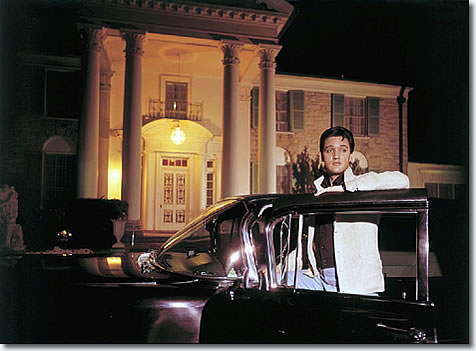
Elvis Presley posed with one of his cars outside Graceland in this photograph published March 7, 1965 in the first issue of Mid-South, the now-defunct Sunday magazine of The Commercial Appeal.
Elvis complained of the long sessions with photographers making movie publicity stills: 'I try to cut the time down to three or four hours, but sometimes you have to pose for six or eight.
A man only has so many different smiles, and I don't have many'.
March 9, Elvis records the soundtrack and does the filming for his 19th motion picture, 'Harum Scarum'. which co-stars Mary Ann Mobley.
March 9, 1965 RCA Studio B - Nashville, Tessessee
Harem Holiday (Vocal Overdub) SPA3 6755-SP
Go East Young Man (Vocal Overdub) SPA3 6751-SP
Mirage (Vocal Overdub) SPA3 6756-SP
March 18, 1965 RCA Studio B - Nashville, Tessessee
Tomorrow Night (Overdub) SPA4 2331
April 7, Girl Happy' opens and is the 25th top-grossing film of the year. The soundtrack hits #8, while the single 'Crying in the Chapel' hits #3.
April 19, 'Harum Scarum' is released.
May 7, Girl Happy opens nationally and does relatively good business. The soundtrack album goes top ten.
Elvis records music and does filming for 'Frankie and Johnny'. co-starring Donna Douglas. On May 9, 1965 Col. Parker has arranged for a special Mother's Day radio show to be broadcast on radio stations across the country.
May 12, 1965 Radio Recorders - Hollywood, California
Come Along (Track) ____-06
Beginners Luck (Track) ____-05
Down By The Riverside / When The Saints Go Marchin' In (Tr) ____-07
May 13, 1965 Radio Recorders - Hollywood, California
Come Along (Vocal Overdub) SPA3 7374-01
Beginners Luck (Vocal Overdub) SPA3 7380-02
Down By The Riverside / When The Saints Go Marchin' In (Vocal Overdub) SPA3 7381-04
Please Don't Stop Loving Me SPA3 7384-19
Shout It Out SPA3 7382-07
Frankie & Johnny (Movie Version Part 1 - Track) ____-03
Frankie & Johnny (Movie Version Part 2 - Track) ____-01
Frankie & Johnny (Movie Version Section 3 - Track) ____-02
Frankie & Johnny (Movie Version Section 4 - Track) ____-03
Frankie & Johnny (Movie Version Section 5 - Track) ____-02
Frankie & Johnny (Movie Version Section 6 - Track) ____-02
Frankie & Johnny (Movie Version Section 7 - Track) ____-04
What Every Woman Lives For (Track) ____-06
Hard Luck (Track) ____-05
May 14, 1965 Radio Recorders - Hollywood, California
Frankie & Johnny (Movie Version Part 1 - Vocal Overdub) ____-05
Frankie & Johnny (Movie Version Section 3 - Vocal Overdub) ____-NA
Frankie & Johnny (Movie Version Section 6 - Vocal Overdub) ____-NA
Frankie & Johnny (Movie Version - Composite) TPA3 3997-SP
What Every Woman Lives For (Vocal Overdub) SPA3 7377-08
Petunia The Gardeners Daughter ____-04
Petunia The Gardeners Daughter (Insert) ____-02
Petunia The Gardeners Daughter SPA3 7375-06
Look Out Broadway SPA3 7379-12
Everybody Come Aboard SPA3 7385-15
Chesay SPA3 7376-07
Frankie & Johnny (Record Version) SPA3 7378-06
May 19, 1965 Goldwyn Studios - Hollywood, California
Hard Luck (Vocal Overdub) SPA3 7383-03
Chesay (Vocal Overdub - Movie Version) ____-NA
July 26, 1965 Radio Recorders - Hollywood, California
Drums Of The Islands (Track) ____-02
Datin' (Track) ____-02
Scratch My Back (Track) ____-04
July 27, 1965 Radio Recorders - Hollywood, California
Stop Where You Are (Track) ____-09
A Dogs Life (Track) ____-05
This Is My Heaven (Track) ____-05
Paradise Hawaiian Style (Track) ____-08
House Of Sand (Track) ____-07
House Of Sand (Track - Part) ____-02
House Of Sand (Track - Part) ____-02
House Of Sand (Track - Composite) ____-SP
Queenie Wahinie's Papaya (Track) ____-03
August 2, 1965 Radio Recorders - Hollywood, California
Drums Of The Islands (Vocal Overdub) ____-06
Drums Of The Islands (Tag Ending - Vocal Overdub) ____-03
Drums Of The Islands (Composite) TPA3 3837-SP
This Is My Heaven (Vocal Overdub) TPA3 3838-SP
Sand Castles ____-10
August 3, 1965 Radio Recorders - Hollywood, California
Sand Castles (Vocal Overdub) ____-01
Sand Castles (Choral Overdub) TPA3 3839-02
Scratch My Back (Vocal Overdub) TPA3 3840-02
Stop Where You Are (Vocal Overdub) ____-03
Stop Where You Are (Tag - Vocal Overdub) ____-09
Stop Where You Are (Composite) TPA3 3841-SP
House Of Sand (Vocal Overdub) TPA3 3842-01
August 4, 1965 Radio Recorders - Hollywood, California
House Of Sand (Movie Opening) ____-07
House Of Sand (Part) ____-01
House Of Sand (Movie Version - Composite) ____-SP
A Dogs Life (Vocal Overdub) ____-06
Datin' (Vocal Overdub) TPA3 3843-14
Queenie Wahinie's Papaya (Vocal Overdub) ____-06
Queenie Wahinie's Papaya (Open - Vocal Overdub) ____-02
Queenie Wahinie's Papaya (Composite) TPA3 3834-SP
Queenie Wahinie's Papaya (Vocal Overdub) TPA3 3835-SP
A Dogs Life (Vocal Overdub) TPA3 3836-09
 |
|---|
| Elvis Presley Hawaii 1965 |
August. 5, Elvis flew to Hawaii for location shooting for teh movie 'Paradise Hawaiian Style'. Much of the shooting for this film was done on location.
While there, Elvis, his father Vernon Presley and manager Colonel Tom Parker visited the U. S. S. . Arizona Memorial, which Elvis' benefit concert in 1961 had helped to build. Together they laid a bell-saped wreath with 1,177 carnations - one for each serviceman lost there in December 1945 during the attack on Pearl Harbor. A party was given on August 18, 1965 at the Polynesian Cultural Center in honor of the film. Singer Peter Noone of the group Herman's Hermits interviewed Elvis there.
Production on the film moved back to the mainland and a few days later on August 27, Elvis meets The Beatles at his house on Perugia Way in Bel Air. Elvis looked so phenomenal that night. He used to wear these bolero shirts and had them in every colour, expect brown. He hated brown! He wearing a blue shirt that night. We all went to the den and all of a sudden we heard screaming, like thunder, as if a bomb went off. The front door opened and outside there were thousands of fans everywhere. The word had got out. What we heard was the front door open as The Beatles walked in! The Beatles came in with Brian Epstein, their manager. They walked up to Elvis and were introduced, and Elvis sits down on the chair. The Beatles all sit down on the floor right in front of Elvis, in a semi-circle, and they look up and they are just gaping & staring at him. There's this dead silence in the room until Elvis says, 'Well, what-the-hell, if you guys aren't going to talk to me I'm going to my bedroom'. And then everyone started to laugh and that broke the ice.
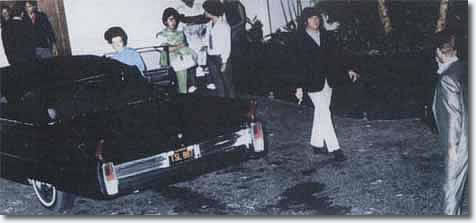
Elvis Presley meets The Beatles : Elvis and John Lennon can be seen in this photo
October 11, 1965 RCA Studio B - New York, New York
Santa Lucia (Overdub) SPA1 6893
Santa Lucia (Overdub) SPA1 6898
Elvis Presley on a go cart racing up the driveway of Graceland October 12, 1965.
November 24, Harum Scarum opens nationwide.
In 1965, Bill Black was in hospital three times, at Baptist Memorial in Memphis, between June and October. This was in an effort to treat a brain tumor which had been found. Sadly, he went into a coma on the last visit, which began on Friday, 8th October.
On Thursday, 21st October, Bill Black, Elvis' original bass singer died during an operation to try and remove part or all of the growth. He was only 39, and just weeks short of his 40th birthday. Ironically, twelve years later, Elvis Presley himself would be pronounced dead at the same hospital. Bill was buried in Forest Hill Cemetery, Memphis. Read about Bill Black.
December 25, Elvis and Priscilla spend Christmas at Graceland.
December 31, Elvis holds a New Years Eve party at the Manhattan club.
Elvis Presley 1966
January 1966 MGM extends Elvis' contract for four more movies. Plans are made to add onto the house what is now known as the trophy room to accommodate Elvis' slot-car tracks. On January 22, 1966, Elvis and Priscilla, along with their friends, build a huge snowman on the front lawn.
February 16, 1966 Radio Recorders - Hollywood, California
Smorgasbord TPA3 5312-07
Stop Look & Listen TPA3 5305-SP
Am I Ready TPA3 5309-07
Beach Shack TPA3 5310-04
February 17, 1966 Radio Recorders - Hollywood, California
Never Say Yes TPA3 5308-SP
Spinout TPA3 5311-05
All That I Am TPA3 5307-05
Adam & Evil TPA3 5306-20
I'll Be Back TPA3 5313-01
Elvis Presley with Country Singer Kitty Wells : March 28, 1966
April, Elvis pays his respects to his mother at Forest Hill Cemetery.
May 25, Elvis meets his new record producer Felton Jarvis and begins working on what will become the album 'How Great Thou Art'. Also during this session, he is especially enthusiastic about working with one of his mentors Jake Hess and his group The Imperials.
 |
|---|
How Great Thou Art LP 1966. |
How Great Thou Art Sessions
May 25, 1966 RCA Studio B - Nashville, Tennessee
Run On TPA4 0908-07
How Great Thou Art TPA4 0909-04
May 26, 1966 RCA Studio B - Nashville, Tennessee
Stand By Me TPA4 0910-11
Where No One Stands Alone ____-04
Down In The Alley TPA4 0912-09
Tomorrow Is A Long Time TPA4 0913-03
Love Letters TPA4 0914-09
May 27, 1966 RCA Studio B - Nashville, Tennessee
So High TPA4 0915-04
Farther Along TPA4 0916-03
By And By TPA4 0917-10
In The Garden TPA4 0918-03
Beyond The Reef TPA4 0919-02
Somebody Bigger Than You And I ____-16
Without Him TPA4 0921-12
May 28, 1966 RCA Studio B - Nashville, Tennessee
If The Lord Wasn't Walking By My Side TPA4 0922-05
Where Could I Go But To The Lord? TPA4 0923-02
Come What May TPA4 0924-08
Fools Fall In Love TPA4 0925-05
June 10, 1966 RCA Studio B - Nashville, Tennessee
Indescribably Blue (Track) ____-NA
I'll Remember You (Track) ____-NA
If Every Day Was Like Christmas(Track) ____-NA
June 12, 1966 RCA Studio B - Nashville, Tennessee
Indescribably Blue (Vocal Overdub) TPA4 0982-02
I'll Remember You (Vocal Overdub) TPA4 0983-SP
If Every Day Was Like Christmas(Vocal Overdub) MWA5 9102-02
June 14, 1966 MGM Sound Stage - Hollywood, California
All That I Am (Overdub) ____-NA
June 20, 1966 RCA Studio B - Nashville, Tessessee
If Every Day Was Like Christmas (Celeste Overdub) TPA4 0984
June 28, 1966 Radio Recorders - Hollywood, California
City By Night (Track) ____-03
Could I Fall In Love ____-06
There Is So Much World To See (Alternate Master) HRA1 8688-10
There Is So Much World To See (Remake) ____-01
Long Legged Girl (Alternate Master) HRA1 8673-06
June 29, 1966 MGM Sound Stage - Hollywood, California
Double Trouble ____-04
Baby If You'll Give Me All Of Your Love ____-05
I Love Only One Girl UPA3 3940-02
It Won't Be Long UPA3 3942-NA
Old MacDonald ____-07
Long Legged Girl (Remake) UPA3 3937-05
Double Trouble (Ending) ____-NA
Double Trouble (Composite) UPA3 3934-SP
June 30, 1966 MGM Sound Stage - Hollywood, California
City By Night (Vocal Overdub) ____-05
Could I Fall In Love (Harmony Vocal Overdub) UPA3 3936-05
Old MacDonald (Vocal Repairs) UPA3 3939-02
July 6, 'Paradise, Hawaiian Style' is released. It lands at #40 for the year. The soundtrack album peaks at #15, while the single 'Love Letters' makes it to #19 on the charts.
July 12, Colonel Parker turns down a Japanese movie deal saying that Elvis is booked through 1969.
July 14, 1966 MGM Sound Stage - Hollywood, California
Baby If You'll Give Me All Of Your Love (Overdub) UPA3 3935-NA
City By Night (Overdub) UPA3 3938-03
August 30, Deciding not to wait until the end of 1967, RCA goes ahead and picks up its option to extend Elvis’ contract until 1974.
September 28, 1966 Paramount Scoring Stage - Hollywood, California
Easy Come Easy Go UPA3 3805-09
I'll Take Love ____-04
I'll Take Love (Pick Up) ____-03
I'll Take Love (Composite) UPA3 3810-SP
Sing You Children UPA3 3809-22
The Love Machine ____-11
September 29, 1966 Paramount Scoring Stage - Hollywood, California
She's A Machine (Movie Version) ____-13
She's A Machine (Record Version) WPA1 8027-15
She's A Machine (Record Version) UPA3 3806-12
She's A Machine (Movie Version) ____-14
Yoga Is As Yoga Does UPA3 3807-12
You Gotta Stop (Track) ____-05
Leave My Woman Alone (Track) WPA3 1039-05
September 30, 1966 Paramount Scoring Stage - Hollywood, California
You Gotta Stop (Vocal Overdub) UPA3 3808-01
November 17, 1966 MGM Sound Stage - Hollywood, California
There Is So Much World To See (Overdub) UPA3 3941
November 23, 'Spinout' opens nationally and is #57 for the year. The soundtrack album goes to #18. Elvis Presley is the 10th highest paid star for the year.
December 1966, Elvis formally proposes marriage to Priscilla.
Elvis' interest in horses becomes serious by December 5 and he purchases riding clothing and equipment. On December 20, he buys Priscilla a horse for Christmas. He also formally proposes marriage just before Christmas, presenting her with a ring.
December 25, Elvis and Priscilla spend Christmas at Graceland.
Elvis' middle name, is it Aron or Aaron?
 50's Masters |
  60's Masters |
  70's Masters
Best Elvis Movies: 12 of His Most Rockin 'n' Rollin' Roles
To learn more about Elvis' Movies see our website Elvis Presley's Movies.


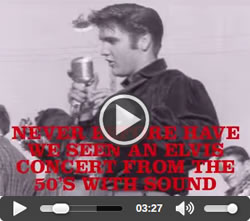

Tupelo's Own Elvis Presley DVD
Never before have we seen an Elvis Presley concert from the 1950's with sound. Until Now! The DVD Contains recently discovered unreleased film of Elvis performing 6 songs, including Heartbreak Hotel and Don't Be Cruel, live in Tupelo Mississippi 1956. Included we see a live performance of the elusive Long Tall Sally seen here for the first time ever. + Plus Bonus DVD Audio.
This is an excellent release no fan should be without it.
The 'parade' footage is good to see as it puts you in the right context with color and b&w footage. The interviews of Elvis' Parents are well worth hearing too. The afternoon show footage is wonderful and electrifying : Here is Elvis in his prime rocking and rolling in front of 11.000 people. Highly recommended.
Tupelo's Own Elvis Presley DVD Video with Sound.