Elvis Presley Video & Audio Interviews | For Elvis Fans Only
We have the latest Elvis videos and audio updates on this page.
Interview with Bobby Wood. Working with Elvis was definitely one of the highlights of my career. I'll never forget those days. We just had a good time.
I grew up in Memphis with Elvis but did not meet Elvis until 1969. I was born into the jewelry business which my father had established in 1937. The night I met Elvis he was shooting at a target on the side of his dad's office. It was raining, and Elvis was wearing a full-length ranch mink coat. Over the period of that year, I got to know Elvis. We went to movies, and football games together. In December 1969, he called me on Christmas Eve and wanted to do his Christmas shopping at around 10:00 or 11:00 at night. I took my briefcase to the Memphian Theatre, a movie house in Memphis where I met Elvis. He sat down, went through my jewelry briefcase and very carefully selected pieces of jewelry for friends, family, his aunt and his dad. From then on I was Elvis' jeweler. He invited me to go on the tours with him, with one requirement that I bring along a case full of jewelry. He loved to give gifts to people he met along the way. Elvis bought a small garnet cross from me. He had it with him when we were in Jackson, Mississippi at a concert, and someone told him about a little boy who was dying. It was a Make-A-Wish Foundation request, and he wanted to see Elvis. So, Elvis agreed, and we took the limo to the hospital where the little boy was staying. Elvis visited with him awhile and then gave him that very cross I had made for Elvis.
Sam Bell grew up with Elvis in Tupelo and in this video interview shares some of his favorite memories of his childhood friend Elvis. Much is covered in this interesting 3 and a half minute video; from a tree house, to church, using a broom as a make believe guitar, Shakrag, Elvis' musical ability and that old chestnut;
racism.
In this video interview with Billy Strange (From 2010, to celebrate his 80th birthday), Billy talks about his friendship with Elvis, writing songs for him with
Mac Davis. Writing Memories, discussing the lyrics with Elvis in the process of writing the song,
A Little Less Conversation and about that songs mega success in 2002. Working with Elvis on the song
Viva Las Vegas, 'I was playing guitar on
Viva Las Vegas ... he liked what I did'. On their friendship he talks about Elvis calling him up 'to his house' and them 'playing with the baby,
Lisa Marie for hours. Billy also talks about working with
Nancy Sinatra and her hit,
These Boots Were Made for Walking and much more.
If Elvis Presley lived, perhaps he would still visit Denver, where it turns out 'The King' struck up some close friendships in the 1970s. Elvis was even made an honorary captain on the city's police force. Robert Cantwell first got to know Elvis in 1970 while working as a guard in a hotel the night Elvis played the Denver Coliseum. When Elvis emerged from an elevator, Cantwell wasn't sure it was him. So he asked for identification. 'He was definitely a country, Southern gentleman', Cantwell tells Colorado Matters host Ryan Warner. 'Off the stage he was a different Elvis. He was a superstar on the stage and a super friend off the stage'.
Elvis Presley co-star Interviews 1992 Part 2 (of a 5 part series).
Bob Chase WOWO Exclusive Interview with Elvis Presley Fort Wayne, Indiana, March 30, 1957.
What instruments did Elvis play? He played guitar, bass and piano, and often toyed with instruments like the drums, accordion and ukulele. While he couldn't read or write music and had no formal lessons, he was a natural musician and played everything by ear. He could often hear a song, pick up an instrument, and play. He often played an instrument in his recordings, and always produced his own music. Elvis was simply born to create music and he was always learning new ways to do it.
Interview with Donna Butterworth who played Jan Kohana in Paradise Hawaiian Style. Donna also appeared in the 1965 film 'The Family Jewels' with Jerry Lewis and received Golden Globe nomination for her role.
Tupelo is a city in the state of Mississippi, which is best known for being the birthplace of Elvis Presley. John Lee Hooker recorded the original version of the song, 'Tupelo' in 1959, which chronicles a flood in Tupelo, 20 years previously. Said Hooker: 'People never forgot it. So when I grew up and got famous, I wrote about it and it brought back memories to a lot of people'. Inspired by John Lee Hooker's song, Nick Cave & the Bad Seeds reworked it as 'Tupelo,' combining imagery of the flood with memories of Elvis Presley. It was released on the Bad Seeds 1985 album The Firstborn is Dead. Here Johm Lee Hooker talks about Elvis, and sings the song 'Tupelo'.
Whitney Houston : 'You don't actually MEET Elvis, you just have to LOOK at Elvis'. She goes on to explain that her mother Cissy Houston (who sang with the gospel group Sweet Inspirations), used to sing back up for Elvis Presley and Aretha Franklin for many years. [Cissy Houston was actually only with Elvis for his opening shows in 1969] and how they were sitting in a room backstage and Elvis walked in with his mink (real fur), glasses on, and she just looked at him and could not say anything (star struck).
Bruce Springsteen was seven when he first saw Elvis on The Ed Sullivan Show. Elvis Presley's third and final appearance took place on January 6, 1957. Watching the show, Springsteen felt mesmerised: 'I couldn't imagine anyone not wanting to be Elvis Presley', he recalled ... 'I jumped up over the wall and I started runnin' up the driveway, which when I look back on it now was kind of a stupid thing to do because I hate it when people do it at my house'.
The Memphis Recording Service (MRS), the producers of the 'Tupelo's Own Elvis Presley DVD, boldly state on the front cover that never before have we ever had live film footage (i.e., with synchronized sound) of an Elvis concert from the 50's ... until this time. Well, we certainly do now! Elvis performing 6 songs, including Heartbreak Hotel and Don't Be Cruel, live in Tupelo Mississippi 1956. Included we see a live performance of the elusive Long Tall Sally seen here for the first time ever. This is an excellent release no fan should be without it.
- The DVD Audio section gives you sound quality superior to CD
- The DVD Video Section Contains both Video Film and synchronized Sound
MRS has ingeniously coordinated licensed, professionally shot black and white newsreel footage (taken at the afternoon September 1956 Tupelo homecoming concert) with the amateur recording made of the concert (which has previously appeared on the Elvis Presley Golden Celebration LP/CD box sets) and it blows you away! Not because of the quality of the footage and audio, but because of the combination! You will hardly believe your eyes and ears!
Olivia Newton-John saw Elvis in concert at least twice but just missed out on meeting the King of rock 'n roll. Olivia: 'I was really excited to be invited to see the King at the Hilton in Las Vegas. It was a celebrity-packed row, with Tim Rice and Andrew Lloyd Webber sitting next to me on either side. After the show, I went backstage to meet him and got another big surprise. Doris Day was there, too - I've always adored her. Doris was warm and welcoming, but sadly I never met Elvis up close and personal. His road manager said there was an emergency and Elvis had to leave the building, Literally!'
Very few women in Elvis' life meant as much to him as Ann-Margret. When Elvis later asked his 'foreman' Joe Esposito, what was so special with Ann-Margret, he replied: - She's the female you.
The two most popular and successful live acts of the 1970s were Elvis Presley and Led Zeppelin, who played to capacity crowds night after night. Coincidentally, both were handled by Concerts West, one of the biggest tour promoters in America. In May 1974, the company offered complimentary tickets to Zeppelin for Elvis' gig at the LA Inglewood Forum, with the possibility of meeting him afterward.
A short independent documentary/interview with Joe Esposito on life with Elvis Presley. We like the part where Joe says 'I don't need this' when referring to the book used as a script of sorts. He was there after all and knew the story.
Interview with Milton Berle who talks about Elvis and his appearance on 'The Milton Berle Show', about his first meeting with Elvis that occurred when his manager wanted Berle to audition him. It was his second appearance on The Milton Berle show that Elvis' performance of 'Hound Dog' drove the audience wild and had the press and some of the viewers appalled. It is one of his most controversial performances.
Graceland, the evening of Thursday, January 9, 1969, one day after Elvis' 34th birthday. Elvis met with RCA producer, Felton Jarvis, in the Jungleroom to discuss going to Nashville to record what he hoped would put him back on top of the charts. Marty Lacker was sitting there in the Jungleroom that evening, seething, as he listened to Elvis and Felton finalize the dates for Nashville. He began to unconsciously shake his head back and forth (his head was big, bald and round and as a result his nickname was Moon). Marty fought back his frustration. Elvis snapped at him, 'What the hell's the matter with you?' and Lacker got the opening he needed to lay it on the line one last time: 'Marty Lacker: I just wish for once you'd try Chips Moman and his rhythm section, they're great Elvis'. And Elvis said, 'Well, maybe someday I will'.
View the 'unboxing', Elvis Presley - Elvis Sings The Mad Professor LP is a Crystal-clear Pic-disc Vinyl and features the best of Elvis sings Ben Weisman. All the songs are mainly alternate tracks between 1956 and 1962 and strictly limited to 1,500 unites worldwide.
Elvis Presley was a Cadillac man and everybody knew it. His taste in cars was especially well-known in his hometown, where folks believed that if you were in the right place at the right time he might suddenly appear out of nowhere and give you the car of your dreams, because that was one of the splendid things about him ...

Mary Tyler Moore talks about Elvis Presley.
Joe Moscheo was a member of the group of gospel singers called The Imperials. The group has been around since 1964 and has had several member changes since then. The Imperials still exist as a Southern gospel contemporary Christian venue. After Elvis' success on NBC in 1968 in a show that's come to be known as the '68 Comeback Special, he went on to play the International Hotel in Las Vegas in 1970. Normally his backup band was the Jordanaires. They had been with him on the television show and had sung with him for a number of years. Unfortunately, due to the success they'd been having, the group wasn't able to do the Vegas shows. Elvis' next choice for backup singers was The Imperials. The group performed with Elvis from 1969 to 1971.
Previously unseen home movie footage which shows Elvis Presley and Johnny Cash together back in 1957 was included in episode four of Ken Burns 'Country Music' documentary series. The clip shows Elvis Presley dancing, possibly to 'Treat Me Nice' from 'Jailhouse Rock'. A Canada Packers sign in the background while Johnny Cash is on the street would suggest that section is filmed in Canada. The first shot is Elvis is chewing gum and dancing - a finger from an unseen man snaps along with his dancing (probably Johnny, based on what comes in a moment).
With Elvis reciting the same stage patter nearly word-for-word in each of the 11 concerts, it's these gaffes and unexpected moments that keep 'Elvis Live 1969' from becoming just an overly repetitive entry for Elvis completists. Instead, the box set serves as a snapshot of a world-class entertainer successfully but gingerly rediscovering the magic that made him so in the first place. 'Suspicious Minds', then just a week or so into its life as a single, is majestic, with Elvis possessed by the pounding rhythm of drummer Ronnie Tutt. The gig is the same one during which Elvis comes to pieces in 'Are You Lonesome Tonight?' supposedly tickled by Sweet Inspirations singer Cissy Houston's ability to keep on singing, unfazed, while Elvis goes further and further off the rails. Still frazzled, he screws up 'Rubberneckin' immediately afterward and asks the band to restart the tune a full 45 seconds in.
Wink Martindale had no idea his life would forever change when he met a truck driver named Elvis Presley in 1954. After listening to the aspiring singer's new track titled 'That's All Right Mama', the radio and game show personality knew there was something magical occurring. And sure enough, Presley quickly transformed into the king of rock 'n' roll. But despite Elvis' reign in both music and Hollywood, the iconic performer passed away on Aug. 16, 1977, at age 42 from a heart attack. Martindale, 85, spoke to Fox News about how he met his beloved pal, their heartbreaking final meeting and how he continues to pursue his own passion to entertain others.
Sony Music have released 'Elvis Live 1969' a Limited Edition 11 CD box set with a 52-page book full of rare photos & memorabilia! The set features one show entirely unreleased and complete and newly mixed and mastered shows.
When
Kurt Russell first started his career, he appeared in a number of television shows and supporting roles in a couple of movies. Not many people realize this, but when Kurt Russell was 10 years old, he was able to act alongside the King himself, Elvis Presley in '
It Happened at the World's Fair'.
'It was my first brush with a real celebrity. I've never seen anything having to do with a real celebrity before. I didn't really know who Elvis Presley was. I was a 10 year old kid. I knew Elvis Presley was a name that everybody knew. If I'd seen him, I didn't know it. I wasn't into music and I didn't listen to music that much. So the first time he came on the set, a car went on the set, round 100's of women just broke through there and jumped on his car.
View a promo video for the Sony Music release 'Elvis Live 1969'. This is a Limited Edition 11 CD box set with a 52-page book full of rare photos & memorabilia! The set features one show entirely unreleased and complete and newly mixed and mastered shows. First chronicled in part on the album Elvis In Person At The International Hotel 50 years ago, Live 1969 showcases this incredibly, important phase in Elvis' career in definitive detail – his first live shows following his triumphant, 1968 comeback for NBC after an 8-year absence from playing live. This box set features 11 complete sets from the first of his many engagements at The International Hotel (several of which are released in full for the first time, with one show entirely unreleased), allowing fans a more definitive picture of The King's glorious return to the concert stage. The 52-page book includes rare photos, memorabilia and an oral history by Ken Sharp curated from historic interviews with Elvis, Colonel Tom Parker, Tom Jones, Jerry Schilling, and more.
On November 9, 1957, Elvis arrived in Hawaii on the Matsonia at 9:00 a.m. and was welcomed by the shrieks of some 4,000 fans. Before he landed, he met the press aboard ship.
Mindy Campbell was a flight attendant and was invited to attend the
Aloha from Hawaii concert. Then, the next day, she was excited to find out that Elvis and his entourage would be passengers on their flight back to Los Angeles. We think you will agree this is a very interesting video and well worth your time.
Angela Lansbury talks about Elvis Presley and Blue Hawaii.
Darlene Tompkins met Elvis Presley in 1961 when she co-starred with him in Blue Hawaii. In this video, she talks about how down to earth Elvis was and his unique laugh.
 Gordon Stoker talks about Elvis Presley
 (02:37) In this video interview Gordon Stoker - a member of The Jordanaires, shares his memories of when they first met Elvis and recording in the studio with him.
On February 14, 1973 Elvis presented Muhammad Ali with an 'Elvis Style' robe emblazoned with the words, 'People's Choice' on the back in rhinestones and jewels. The wording was a mistake as Ali was known as the 'The Peoples Champion'. Elvis was very upset about this but it too late. Ali thanked Elvis for the robe then went directly to the Las Vegas Convention Center for his fight that night against Joe Bugner where he wore Elvis' robe for the first time. Often the story is told he did not wear it this night, but he sure did, and he won the fight too! Sammy Davis Jr was ringside for the fight and bought into the ring post fight by Ali.
Lisa Marie Presley is joined by co-producer Joel Weinshanker in
Graceland to chat to Ross King about recording a special duet with her father, Elvis Presley, 41 years since his death.
Listen to an exclusive premiere of 'Saved', featuring new backing vocals by the legendary Darlene Love, one of 14 tracks on the inspirational new album, 'Where No One Stands Alone' - available August 10. The groundbreaking new album, 'Elvis Presley - Where No One Stands Alone', released on August 10, features 14 original performances of gospel songs with newly recorded instrumentation and backing vocals, all in support of Elvis' original lead vocal recordings. 'Saved' is an energetic gospel-rock call-and-response tune with some fun rhythmic twists, sassy lyrics and Darlene Love jumping in on background vocals. And in classic Elvis fashion, the king testifies as he gives up his errant ways. Love, who first sang with Elvis on his 1968 NBC television special, shares, 'I had the honor to perform a terrific version of Jerry Leiber and Mike Stoller's 'Saved' on the popular ABC TV show Shindig in 1965 with The Blossoms as the lead vocalist. Though we never recorded it officially it predates Elvis' version which I sang background vocals for with the group'.
Here is an inside look at the upcoming new multi-part documentary Elvis Presley: The Searcher.
Listen to Priscilla Presley & Jerry Schilling talk about how to explain Colonel Tom Parker accurately in 'Elvis Presley: The Searcher'. Q: How do you resist making the Colonel the bad guy?
Listen to Priscilla Presley & Jerry Schilling talk about Gladys Presley singing 'Home Sweet Home'. As included in the Sony release
Elvis Presley: The Searcher Deluxe 3 CD set in 8"x 8" with a 40-page book in slipcase.
Elvis in Blade Runner 2049: One of the best films of last year was 'Blade Runner 2049' by director Denis Villeneuve. It was the sequel to the 1982 'Blade Runner' and stared Ryan Gosling and Harrison Ford. Set thirty years after the first film, Ryan Gosling plays K, a blade runner. And, Yes, in 2049 ELVIS is still relevant! His great musical legacy continues and his holographic image is still playing in Las Vegas. In a delightful touch ELVIS is still playing in Las Vegas but now as a hologram.
View the scene.
Coming from a 1st Generation digital copy of a actual TV Station broadcast tape, (originally used to broadcast 'The Special' in October 1977) and re-mastered frame by frame, the
1977 CBS TV Special, for the first time ever, is in near perfect quality, and is a very special treat for fans!
Elvis '77 DVD Series consists of 9 DVDs. The contents of the DVDs are; ... The
1977 CBS TV Special is in perfect quality, a very special treat for fans. For the first time ever, using a 1st Generation digital copy of a TV Station tape, (originally used to broadcast 'The Special' in October 1977) it has been re-mastered frame by frame and now finally, released to fans to watch this in all its glory! Then there are two DVDs with the
Omaha June 19 show from a new tape source with unreleased footage for the first time and the
Rapid City June 21st concert from a new tape source with unreleased footage and near 100% complete for the first time.
While it is a very short clip, it is still previously unseen. Elvis Presley's first Toronto concert, on April 2, 1957.
So many of us have spent Christmas with Elvis' music, but
Priscilla Presley actually spent Christmas with Elvis. Priscilla shares heartwarming memories of holidays with the King, from the first time they ever exchanged gifts to their tree-trimming traditions as a married couple living at Graceland, to how that changed when Priscilla gave birth to their daughter,
Lisa Marie, and how Priscilla feels when she hears Elvis' music now.
Jocelyn 'Jackie' Lane was born Jocelyn Olga Bolton in Vienna, Austria in 1937. Today she was married to Prince Alfonso of Hohenlohe-Langenburg. In 1965, she co-starred with
Elvis Presley in
Tickle Me and later appeared in several roles in Hollywood films, including as 'biker chick' Cathy in Hell's Belles in 1969. She also made guest appearances on American television series. She retired in 1971 after marrying Prince Alfonso of Hohenlohe-Langenburg in Marbella, Spain on 3 May 1973
As the bassist of the most iconic rock and roll band, The Beatles, Paul McCartney played bass gutair. In this clip he shows his talents on the upright bass. But not just any upright bass. The 'upright' as many call it officially known as the 'double bass', is the acoustic early version of the electric modern day bass guitar that would become Paul's role in The Beatles. Paul reveals the original
Elvis Presley bass, played by
Bill Black, and sings '
Heartbreak Hotel'.
The Beatles talking about meeting Elvis Presley.
This is a video interview with
Shelley Fabares on American Bandstand in 1965. Shelley starred with Elvis Presley in the 1965 movie
Girl Happy, was one of three leading ladies in '
Spinout'. Adding to her lineup of movies with Elvis, the following year she starred in '
Clambake', her third starring role alongside the King. 'I loved doing those pictures', said Fabares. 'It's a happy memory for me, they were great fun'.
Singer, 'Morrissey' is currently opening his concerts with a memorable - and faithful - run through the Elvis Presley nugget 'You'll Be Gone'. Morrissey's version shook with swagger, in a fashion that surely would've pleased the King of Rock and Roll. He has performed the song in concert since 2015. And isn't is so cool he has chosen this song and the one that Elvis had a genuine writing credit on (Red West / Elvis Presley / Charlie Hodge). Steven Patrick Morrissey, known mononymously as Morrissey, rose to prominence as the lead singer of the Smiths. The Smiths recorded '
His Latest Flame', Elvis' 1961 hit. His father was an Elvis-fan and one of Morrisseys friends is
Nancy Sinatra. There are several live versions, we have picked the one with the best sound quality.

Never before have we seen an Elvis Presley concert from the 1950's with sound. Until Now! The DVD Contains recently discovered unreleased film of Elvis performing 6 songs, including Heartbreak Hotel and Don't Be Cruel, live in Tupelo Mississippi 1956. Included we see a live performance of the elusive Long Tall Sally seen here for the first time ever.
+ Plus Bonus DVD Audio.
This is an excellent release no fan should be without it.
The 'parade' footage is good to see as it puts you in the right context with color and b&w footage. The interviews of Elvis' Parents are well worth hearing too. The afternoon show footage is wonderful and electrifying : Here is Elvis in his prime rocking and rolling in front of 11.000 people. Highly recommended.
Tupelo's Own Elvis Presley DVD Video with Sound.




 next page >>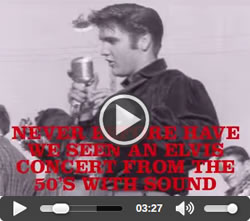

 Tupelo's Own Elvis Presley DVD